
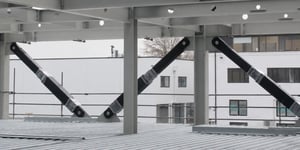
TECTONUS DMAX
Straight Swap for BRBs, EBFs, CBFs
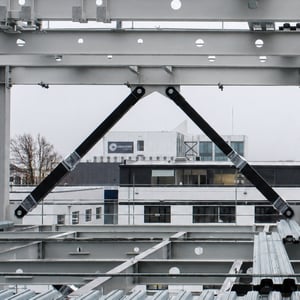
Tectonus DMAX is a steel brace supplied end to end, with some advantages compared to other bracing systems:
- Elastic Perfectly Plastic hysteresis
- Best-in-class Overstrength Factor - 1.15
- Damping, drifts and ductility equivalent to BRBs
- No yielding parts
- Individually tuned and tested
DMAX incorporates the well-proven Tectonus DFFJ friction damper.
Value Engineering Opportunity
Assuming the same ductility for three different bracing systems, the table shows the impact of overstrength on capacity design.
Reducing forces into adjacent elements can trigger a cascade of system-level reductions across gussets, columns, connections, and foundations.
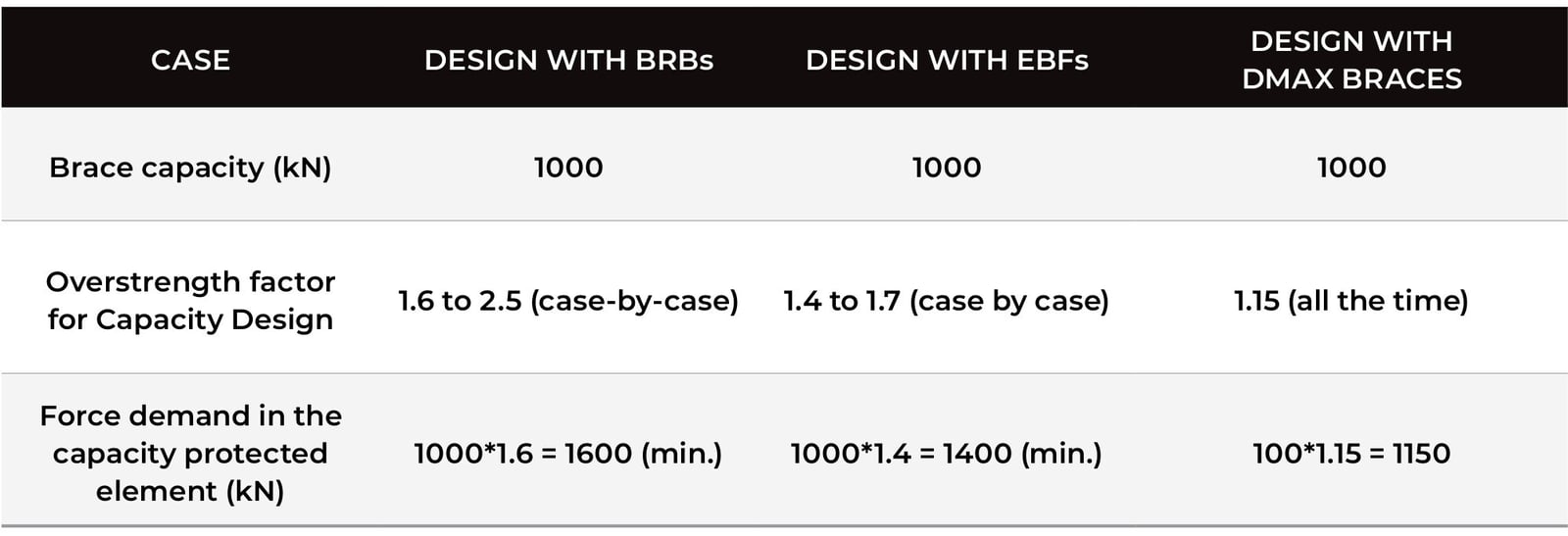
Note that DMAX ductility can be further optimized via non-linear methods, if desired.
Design Example - US Datacenter
The impact of overstrength can be seen in this design example: a two-storey 135,00 sq ft (12,410m2) data center on West Coast USA.
Originally designed with BRBs, the design was updated with Tectonus DMAX braces, and the impact of lower overstrength was quantified.
| Conventional BRB | Tectonus DMAX |
| R = 8 | R = 8 |
| Max drift <2% | Max drift <2% |
| Overstrength ≈ 2.0 | Overstrength = 1.15 |
| Max brace force ≈ 8,530 kN | Max brace force ≈ 4,905 kN |
On this project, the reduction in maximum brace force resulted in a 40.3% reduction in structural steel weight.

Stable & Precise Performance
- Energy dissipation via controlled friction, not yielding
- Elastic-perfectly-plastic hysteresis - repeatable over 100s of cycles
- No strength gain with deformation or velocity
- Load tunable to within 10kN
- Built-in anti-buckling mechanism
- Stability over time proven in testing:
- Proprietary materials (not steel on steel)
- Velocity independence
- Temperature and wear stability
- Every device is tested before shipment.
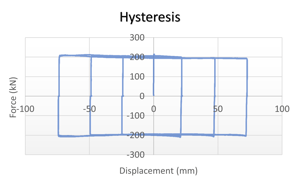
DMAX has been tested to ASCE 7
- DMAX brace was tested according to ASCE 7 at AUT Structures Lab
- Prototype tested against OSHPD/HCAI protocols in a 17025-certified US lab
- The DFFJ damper has been component tested according to ASCE 7-16 loading protocols
- Reports are available upon request.
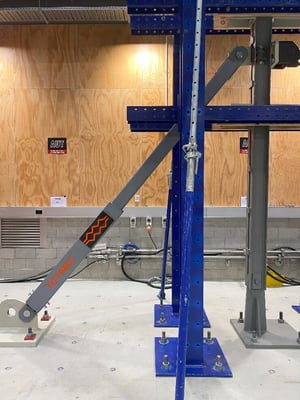
Constructability
- Modular design allows for finger shimming mid-brace
- Allows for length adjustment on-site
- Tolerances better than AISC-approved 1/32”
- HS sections can fit within standard wall profiles
- Surfaces primed and ready to paint
- No beam link detailing cf. EBFs
- Retrofits: minimal gusset or foundation strengthening
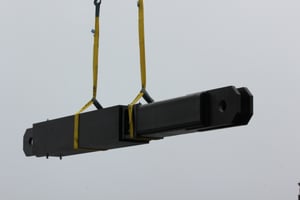
How it works
DMAX is a steel tension and compression brace supplied end to end.
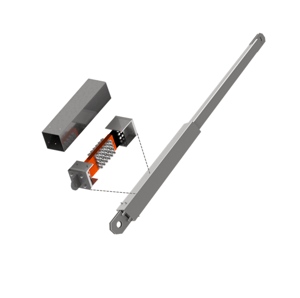
The brace incorporates Tectonus DFFJ friction damper technology and a proprietary mechanism to control global buckling.
In an earthquake, energy dissipation is provided by controlled sliding of the friction surfaces. These surfaces have a proprietary surface covering to ensure stable performance across a range of frequencies— and pre-tensioned disc springs to adjust the clamping force.
There are no yielding components, allowing DMAX to perform through multiple earthquake events. There is nothing to replace post-earthquake.
Project Feasibility
To quickly assess project feasibility, replace the brace element or BRB and use the following factors for DMAX:
| USA | CANADA | NEW ZEALAND | |
| Ductility | 8 (R) | 4.8 (RdR0) | 3.5 (μ) |
| Overstrength /Capacity Design | 1.15 | 1.15 | 1.15 |
Worked Example
For example, taking a 1000 kN BRB which has an overstrength factor of 1.6 - 2.5 and replacing it with a 1000 kN DMAX brace with overstrength of 1.15 means the capacity design of the connections, members, and foundations can be downscaled from 1600-2500kN for the BRB example to 1150 kN for DMAX.
Modelling Guidance
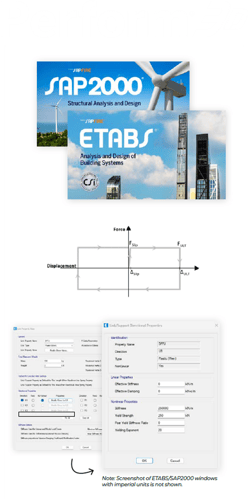
Typically the DMAX ductility factor can be improved through further modeling and analysis (involving nonlinear time history analysis).
To model DMAX braces, follow these instructions:
- In ETABS and SAP2000, use ‘Plastic-Wen’ Link element
- In PERFORM3D, use an ‘Inelastic Bar’ element with E-P-P properties
For further modeling guidance, please check out the following video tutorial.
If at any stage you need help please don't hesitate to get in touch.